
Getting your P-plates in Victoria is one of the “coming of age” moments in a young person’s life. The supervision and tedious 120 hours of logbook entries are done, and now the exhilarating autonomy of the open road. However, this freedom is tempered by a unique set of rules, such as restrictions on passengers and which cars you can drive. Many P platers are now looking for the next life achievement of buying their first car, and now there are many electric and plug-in hybrid vehicles on offer, but how do you know which ones are legal for a P plater?
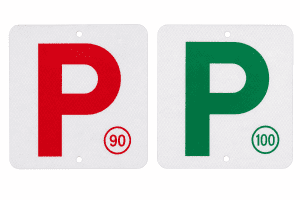
One restriction that applies to both the Red P-plate (P1) and Green P-plate (P2) categories is that they are prohibited from driving high-performance vehicles unless an exemption applies. Restrictions on high-performance vehicles for Victorian P-platers are primarily designed to reduce road trauma and mitigate the specific risks posed by inexperience combined with high acceleration and power—data from the Transport Accident Commission (TAC) and Victoria Police support this.
- Drivers in their first year of solo driving are almost 4 times more likely to be involved in a fatal or serious injury crash than experienced motorists.
- While young people aged 18–25 make up only about 10% of Victorian licence holders, they represent approximately 17–18% of driver fatalities.
- Research estimated that injuries in high-performance vehicles owned by young people increased by 101% compared to those in other vehicle types.
Reviews and study results suggest that inexperienced drivers lack the “hazard perception” skills to manage high acceleration safely, and drivers who value high acceleration and powerful engines are more likely to commit traffic violations and engage in reckless driving.
What is the power-to-weight ratio?
In the past, there was a blanket ban on turbocharged, supercharged, or eight-cylinder or higher vehicles, as well as aftermarket performance upgrades, because these were perceived as fast cars and were thought to cause trouble when combined with a P plater. The rules changed in 2014 to a 130kW per tonne power-to-weight ratio to better reflect performance regardless of engine size or configuration, as many modern small cars were banned under the old rules because they were turbocharged.
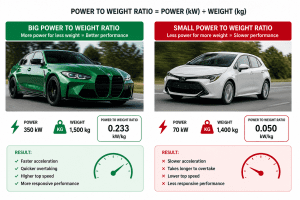
At its simplest, the power-to-weight ratio is a calculation of how much “muscle” (power) a vehicle has relative to its “heaviness” (weight). Two cars might have the same 150kW engine, but if one is a tiny hatchback and the other is a massive 4WD, the hatchback will be much more dangerous in the hands of a beginner because it will accelerate like a rocket compared to the big, heavy 4WD.
What about EVs and PHEVs?
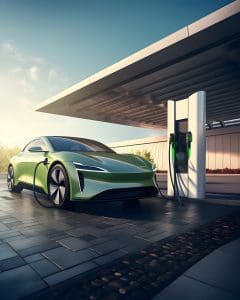
In street-racing terms, a “Sleeper” is a car that lacks typical sporty features and looks so that it can blend into traffic without a second glance. Despite their plain or unkempt appearance, these cars hide a high-performance engine and driveline to surprise other drivers who want to drag race illegally away from the lights. In the Australian market, some Electric Vehicles (EVs) and Plug-in Hybrid Electric Vehicles (PHEVs) have reputations as “sleepers” due to their high power-to-weight ratios and family car looks.
For P plate drivers, the 130kW per tonne power-to-weight ratio applies to vehicles with an electric driveline; as a result, most dual-motor and performance models are banned, while many single-motor models are below the power-to-weight threshold.
However, you need to double-check, as this is not a hard-and-fast rule, and driving a prohibited vehicle can lead to fines, demerit points, and licence suspension. VicRoads has a searchable database where you can look up the banned status of specific models.
https://vicroadssafevehicles.carsalesnetwork.com.au/#/search
Exemptions
There are exceptions to every rule, and there are situations where a P-plater can drive a vehicle with a power-to-weight ratio above 130kW per tonne. There are extra rules and an application process for an exemption. For more details on these exemptions, visit the following page on the Transport Victoria website.
The long story short is that P platers can drive some EV and PHEV cars, but it is up to the driver to ensure the unsuspecting car they are sliding behind the wheel of is not a sleeper that will get them into trouble.
