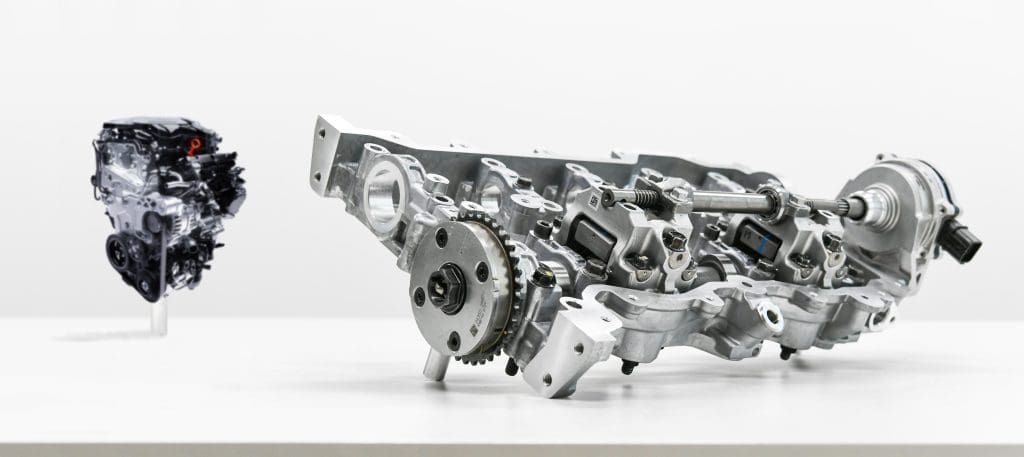
In 2019, the Hyundai Motor Group released the world’s first production engine with Continuously Variable Valve Timing (CVVT) and Continuously Variable Valve Duration (CVVD) in their new Smartstream G1.6 T-GDi engine. CVVD is an innovation that increases power and efficiency while reducing emissions. This is an overview of the components and operation if you need to work on one of these engines.
Engine valve timing and camshaft profiles in older engines were static and a compromise to give a smooth idle and reasonable power output. Performance engines could have more aggressive cam timing and lobe profiles for high output at higher rpms, but poor idle and drivability at low speeds. This compromise has led engineers to develop systems to alter camshaft timing and, in some cases, adjust camshaft lift across the engine’s rev range to achieve the best of both worlds. Variable Valve Timing (VVT) is now very common on modern engines, and there are many different methods and marketing names, but altering the duration the valve is open has been a challenge.
Hyundai Motor Group has overcome this limitation with the creation of its Continuously Variable Valve Duration (CVVD), which is made up of three main components.
- Camshaft, which contains the inner and outer shafts and the linkages
- CVVD mechanism to change the position of the linkages in the camshaft
- CVVD Actuator to rotate the CVVD mechanism in the correct direction.
In some of Hyundai and Kia’s marketing materials, they point out that “ICE technologies are already at or near the apex point,” meaning there are very few easy gains left to increase power while reducing emissions. So the addition of extra systems, like CVVD, is now required to meet expectations. It will be interesting to see if other engine manufacturers will adopt similar systems moving forward.
For an excellent explanation of how all of this works, see the video produced by Engineering Explained
The World’s First CVVD Engine – Genius!
For more details and the special tools required to work on this system, refer to the April 2026 issue of VACC’s TechTalk magazine.